Checking Out the Fundamentals of Welding Examination: An In-depth Assessment of Procedures, Tools, and the Significance of Quality Control in Welding Industries
Welding evaluation serves as a foundation in the upkeep of security and architectural honesty throughout different markets. Recognizing the ramifications of these practices increases vital inquiries about their efficiency and the future direction of top quality guarantee in welding.
Value of Welding Assessment
Welding assessment plays an important function in making certain the integrity and safety of welded structures. It functions as a methodical strategy to evaluating weld quality, identifying possible defects, and making certain compliance with well established standards and specs. The importance of welding assessment expands beyond plain adherence to regulations; it is critical in guarding human lives and securing financial investments in framework.
Malfunctioning welds can lead to tragic failures, causing substantial financial losses, injury, or loss of life. Strenuous assessment processes are important to identify problems such as poor infiltration, porosity, or cracks prior to they intensify right into critical failures. Furthermore, efficient welding assessment adds to the general efficiency and longevity of frameworks, making sure that they can endure the problems for which they were designed.
In addition, the implementation of welding evaluation fosters a society of high quality and liability within the welding market. By focusing on evaluation, companies demonstrate their commitment to excellence, consequently enhancing their online reputation and competitiveness in the market. Inevitably, welding assessment is not simply a step-by-step step yet an essential element of design integrity and security guarantee, vital for the successful execution of welding jobs across various fields.
Key Evaluation Processes
An extensive technique to welding inspection entails numerous crucial processes that are crucial for making sure weld high quality and architectural honesty. The initial important process is visual examination, which permits assessors to identify surface area defects such as cracks, porosity, and incorrect grain appearance. This method functions as a preliminary analysis to make sure that the weld meets defined criteria.
In addition, destructive screening may be performed on example welds to examine their mechanical residential properties and performance under stress. This process entails tensile, effect, and exhaustion screening to validate that the weld can stand up to operational problems.
Finally, documents and reporting are important parts of the assessment process. Maintaining precise documents of evaluations, monitorings, and examination results assists make sure compliance with industry criteria and assists in regular enhancement in welding practices. Jointly, these essential procedures form the foundation of reliable welding inspection and quality guarantee.
Devices for Weld Evaluation
Countless devices are vital for efficient weld examination, each designed to assess various aspects of weld top quality and efficiency. Among one of the most widely utilized are aesthetic inspection tools, consisting of magnifying glasses and borescopes, which make it possible for inspectors to identify surface area problems such as cracks, porosity, and incorrect combination.
Furthermore, ultrasonic screening (UT) tools is vital for identifying inner flaws. This tool uses high-frequency acoustic waves to expose gaps within the weld, ensuring the honesty of the material. Radiographic testing (RT) tools, which utilize X-rays or gamma rays, similarly give understanding right into the interior structure of welds, permitting the identification of additions or gaps.
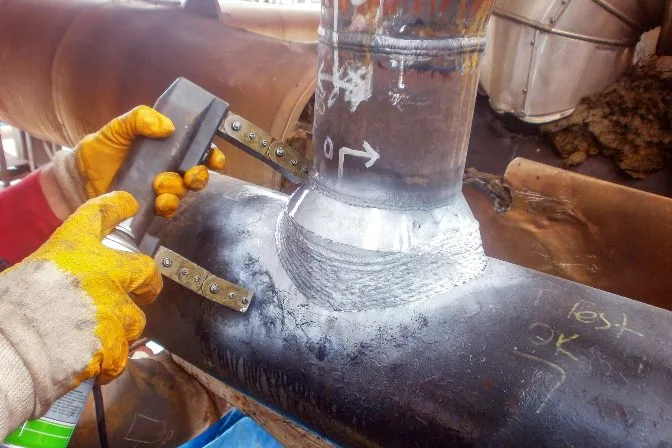
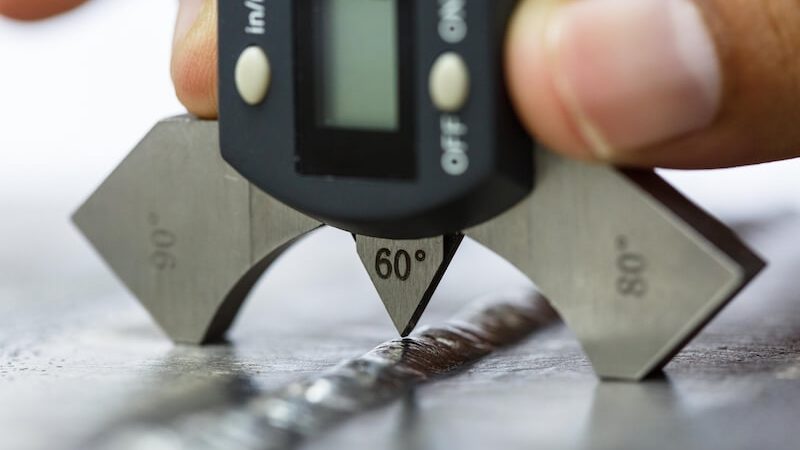
For exact dimensions, calipers and evaluates play a significant role in identifying weld dimensions and guaranteeing adherence to defined resistances. Firmness testers assess the mechanical buildings of the weld, guaranteeing it satisfies efficiency standards.
Strategies for Analyzing Quality
Just how can the quality of welds be accurately examined? A range of methods are used to examine weld integrity and make certain adherence to specified standards. Aesthetic assessment is the most essential method, enabling assessors to identify surface area problems such as cracks, porosity, or damaging. This non-destructive technique functions as an initial analysis before advanced methods are utilized.
Ultrasonic screening (UT) is an additional popular strategy that uses high-frequency acoustic waves to spot interior flaws within the weld. Houston Welding Inspection. This technique gives a comprehensive sight of the weld's stability without endangering its structural stability. Furthermore, radiographic screening (RT) employs X-rays or gamma rays to expose internal problems, offering thorough understandings right into weld quality
Magnetic bit screening (MT) is reliable for spotting surface and near-surface stoppages in ferromagnetic materials, utilizing electromagnetic this page fields and tinted fragments to highlight issues. Lastly, dye penetrant testing (PT) can be employed to reveal surface-breaking flaws by applying a dye that seeps right into splits and is subsequently revealed.
Compliance With Industry Criteria
Compliance with industry standards is essential for guaranteeing the high quality and safety and security of bonded structures. These requirements, established by organizations such as the American Welding look at this web-site Society (AWS) and the American National Standards Institute (ANSI), provide standards that control the welding procedure, products, and assessment procedures. Sticking to these standards not just makes certain the architectural stability of welds however also mitigates threats linked with failings that might cause disastrous repercussions.

Welding examiners are tasked with confirming compliance with these criteria throughout the welding procedure (Houston Welding Inspection). This involves evaluating welding procedures, checking welder certifications, and performing comprehensive examinations of the last product. Non-compliance can lead to substantial financial effects, task delays, and damages to a company's online reputation
Moreover, conformity promotes a society of high quality control within the company. By establishing clear assumptions and benchmarks, firms can preserve uniformity in their output and boost overall efficiency. Routine training and updates on standards are important to maintain personnel educated and competent, ensuring that all elements of welding procedures meet or surpass governing requirements. Eventually, dedication to industry requirements offers as a foundation for excellence in the welding market, advertising safety and dependability in bonded frameworks.
Verdict
In conclusion, welding examination serves as an essential part in preserving the safety and honesty of bonded structures. Adherence to sector requirements ensures conformity and resource advertises a culture of quality within the welding sector.
Furthermore, the implementation of welding evaluation cultivates a culture of quality and responsibility within the welding industry. Inevitably, welding evaluation is not just a procedural action however a basic element of design integrity and safety and security assurance, crucial for the successful implementation of welding tasks across various markets.
A comprehensive technique to welding inspection includes numerous essential procedures that are essential for making sure weld quality and structural stability. These criteria, established by organizations such as the American Welding Culture (AWS) and the American National Standards Institute (ANSI), offer standards that govern the welding process, products, and examination protocols.Welding examiners are entrusted with validating compliance with these criteria throughout the welding process.